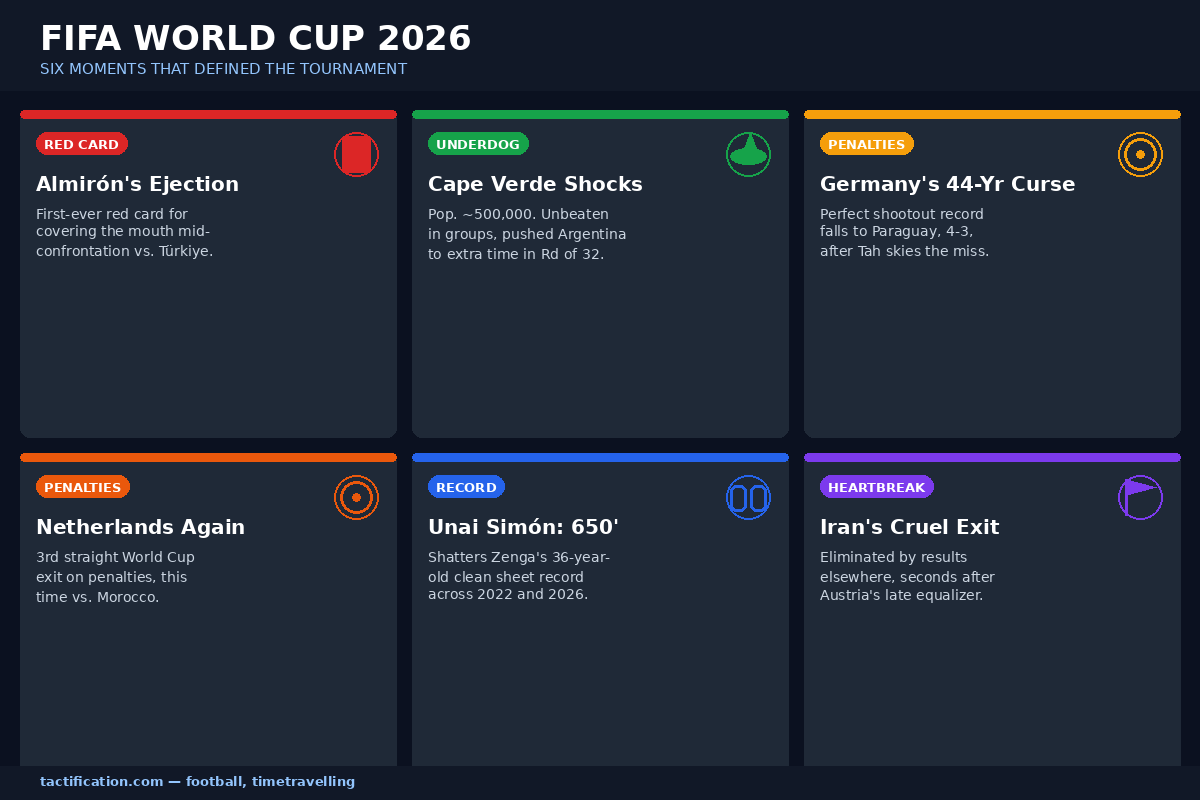
The curtain falls on the FIFA World Cup 2026 — and now it's a four-year wait until 2030, co-hosted by Morocco, Portugal, and reigning champions Spain. This edition delivered brilliant football throughout, with Spain, France, and others setting the standard. My one disappointment was Argentina, my favourite team, who fell short both on the scoreboard and in how they carried themselves. Below are the World Cup 2026 highlights that stood out most — the records broken, the upsets nobody saw coming, and the heartbreak that came with them.
Miguel Almirón Red Card: Football's First Mouth-Cover Ejection
A new FIFA rule made its World Cup debut in the most dramatic way possible.
In the dying seconds of the first half, Paraguay's Miguel Almirón and Türkiye's Mert Müldür clashed near midfield after a hard foul. Almirón cupped his hand over his mouth as he fired back a retort — a gesture players make constantly without a second thought. This time, it cost him everything. Müldür appealed to the referee, VAR confirmed it, and Almirón became the first player in World Cup history sent off under football's newest rule.
The law wasn't born from nothing. Months earlier, a Champions League night between Benfica and Real Madrid had erupted in controversy when a player was accused of hiding ugly words behind his shirt, aimed at Vinícius Júnior — serious enough to stop the match. FIFA's answer was blunt: cover your mouth mid-confrontation, and you're gone. Almirón became its first real-world test case — and, against all logic, his exit only lit a fire under his team.
Cape Verde World Cup 2026: Africa's Tiny Giant Shocks the World
The smallest African nation to ever qualify became one of the tournament's biggest stories.
Cape Verde is a ten-island archipelago off West Africa's coast, home to barely 500,000 people. No football pedigree, no giant academies — yet at the 2026 World Cup, this speck of a nation faced Spain, Uruguay, and Saudi Arabia and never lost. A 0-0 draw with Spain, a stunning 2-2 comeback against Uruguay, another clean sheet against Saudi Arabia — three games, no defeats, and a shock place in the knockouts.
Ranked 67th in the world, Cape Verde then drew Lionel Messi's Argentina in the Round of 32. They pushed the world champions to extra time, level at 2-2, before finally falling 3-2 in the 111th minute. The scoreline said loss; the story said something bigger — a nation of half a million had made the champions sweat, proving belief can rival history on football's grandest stage.
Germany Penalty Shootout Record Ends After 44 Years
One of football's longest-standing records finally fell — against Paraguay, of all teams.
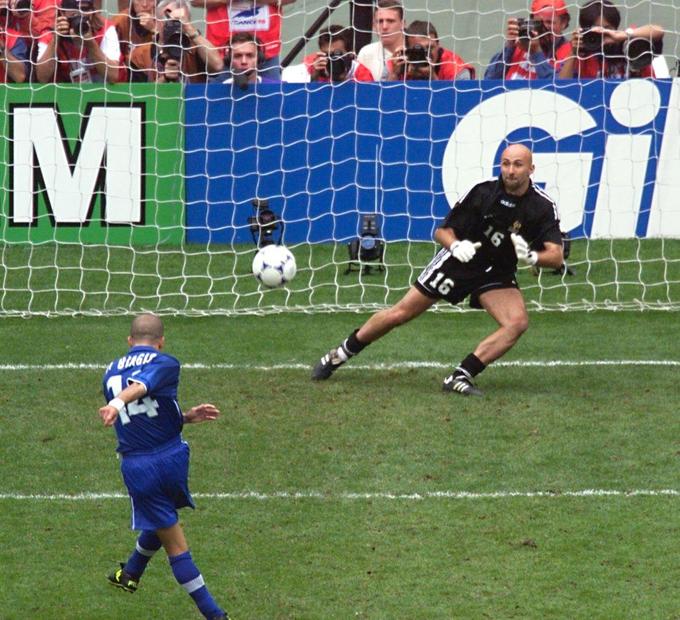
For 44 years, one line in football's record books never changed: Germany do not lose World Cup penalty shootouts. It started in 1982, beating France despite Uli Stielike missing a kick. They won again in 1986 against Mexico, in 1990 against England, and in 2006 against Argentina — four shootouts, four wins, only one missed kick out of eighteen taken. Players call penalties a lottery. For Germany, it looked more like a guarantee.
That guarantee ended in the Round of 32 against Paraguay. Germany missed twice in normal penalties, forcing sudden death for the first time in their history — and then Jonathan Tah's shot sailed high over the crossbar, missing the target entirely. José Canale converted the winner, and Paraguay walked away 4-3 winners on penalties, ending not just Germany's World Cup, but a 44-year statistic that had outlasted generations of players and tournaments.
Netherlands Penalty Shootout Curse Strikes Again
A third straight World Cup, a third straight exit on spot kicks.
The Netherlands have built one of football's cruelest reputations: brilliant enough to reach the biggest stages, cursed enough to never survive them on penalties. Their history began badly and rarely improved — four straight shootout losses to open their record, then heartbreak in the 1998 semi-final against Brazil and the 2014 semi-final against Argentina, each time with a place in the World Cup final on the line. Their only tournament win came in 2014 against Costa Rica, salvaged by substitute goalkeeper Tim Krul. Everywhere else, the story repeated itself — Argentina again in 2022, this time in the quarter-finals, Virgil van Dijk and Steven Berghuis both saved.
At the 2026 World Cup, the pattern found new ways to hurt. Cody Gakpo's 72nd-minute goal put the Dutch ahead against Morocco, only for Issa Diop's header to drag it to extra time and, inevitably, penalties. Justin Kluivert, Quenten Timber, and Crysencio Summerville all missed, and Morocco advanced — the Netherlands' third straight World Cup exit on spot kicks, and their fourth shootout loss in five attempts. For a golden generation of Dutch talent, the shootout has become less a lottery than a familiar wall they cannot find a way past.
Unai Simón World Cup Record: 650 Minutes Without Conceding
A 36-year-old goalkeeping record, broken across two tournaments.
Some records get broken by a single unforgettable performance. Unai Simón's took two entire World Cups. The Spanish goalkeeper's clean-sheet streak began quietly in Qatar 2022 — the final 39 minutes against Japan, then a full 120 scoreless minutes against Morocco in the Round of 16. Nobody was counting the clock yet. Four years later, Simón picked up exactly where he left off, keeping Spain spotless through the entire 2026 group stage against Cape Verde, Saudi Arabia, and Uruguay, then again in the knockout win over Austria. Match by match, the streak kept climbing without anyone scoring against him at all.
By the time Spain reached the quarter-finals, Simón had gone 650 consecutive minutes without conceding — shattering Walter Zenga's legendary 517-minute record from Italy 1990, a mark that had stood untouched for 36 years, and surpassing Spanish legend Iker Casillas along the way. The run finally ended in the 41st minute of the quarter-final, when Belgium's Charles De Ketelaere found the net. It was Simón's only goal conceded in the entire tournament — a fitting end to a streak that had outlasted an entire generation of goalkeepers, and one that even Guinness World Records recognized as the longest in World Cup history.
Iran World Cup 2026: Heartbreak, Politics, and Grace Under Pressure
A campaign shaped by geopolitics, decided by a whistle hundreds of miles away.
For Iran, the 2026 World Cup was never just about football. With the US and Israel's conflict with Iran shaping every logistical decision, the team shifted its base camp from Arizona to Tijuana, Mexico, fearing visa complications — and after every match played on US soil, players were forced to fly back across the border within hours of the final whistle. Amid all of it, Team Melli went unbeaten through the group stage, drawing all three matches, including a tense 1-1 result against Egypt in Seattle.
The ending was pure cruelty, stretched out across an agonizing final day. In stoppage time against Egypt, defender Shoja Khalilzadeh appeared to score a stoppage-time winner that would have sent Iran through — only for VAR to rule it out for offside, a call so marginal it sparked fierce debate among fans. What followed was a day of watching other scoreboards instead of their own. Iran needed Ghana to beat Croatia; Croatia won instead. They needed Uzbekistan to beat or draw the Democratic Republic of Congo; the Congolese came back from a goal down to win. Then, one final flicker: Riyad Mahrez scored in stoppage time to put Algeria 3-2 up over Austria, a result that alone could keep Iran alive. Roughly 120 seconds later, Austria equalized, and Iran's World Cup was over — eliminated not by a ball they kicked, but by full-time whistles blowing hundreds of miles away.
What FIFA Got Right at the 2026 World Cup
Before the wait for 2030 begins, a few things stood out that genuinely improved the quality of the game this edition. FIFA's new rule sending time-wasting players off the field for a minute was a smart, overdue fix. The semi-automated offside technology also did its job well, cutting out the frustrating VAR delays that still plague the European leagues.
On a more personal note, it's bittersweet watching icons like Messi, Modrić, Neymar, and Ronaldo edge toward the end of their World Cup stages. Watching them play the sport they loved, inspiring billions of fans along the way, was a privilege — and this tournament may be the last time we see some of them do it.