From royal interventions to political boycotts, when teams refused to play.
Football has witnessed countless controversies over its 150-year history, but few moments capture the raw emotion and
defiance of the beautiful game quite like when an entire team decides to walk off the pitch.
These are not mere tantrums—they are statements, protests, and sometimes, the only response left
when players feel justice has abandoned them. From the sands of Spain in 1982 to the chaos in
Morocco by Senegal in 2026, here are the most dramatic walk-offs that shook world football.
The Prince Who Overruled the Referee: Kuwait vs France, 1982 World Cup
The 1982 World Cup in Spain was supposed to be
Kuwait's moment of glory—the first Gulf nation
to qualify for football's grandest stage. But their match against France
on June 21st in Valladolid
would become infamous for the wrong reason. With France leading 3-1, midfielder
Alain Giresse found the
net for what appeared to be France's fourth goal. The Kuwaiti players, however,
had stopped playing—they claimed to have heard a whistle from the crowd and assumed play had been halted.
What happened next remains unprecedented in World Cup history.
Sheikh Fahad Al-Ahmed Al-Jaber Al-Sabah,
brother of the Kuwaiti Emir and president of the Kuwait Football Association,
marched onto the pitch in his traditional white robes. He confronted Soviet referee
Miroslav Stupar directly,
gesturing furiously as Kuwaiti players surrounded them. The standoff lasted several minutes,
and astonishingly, Stupar buckled under the pressure. He reversed his decision and disallowed the
goal—the only time in World Cup history that a spectator has successfully overturned a referee's ruling.
The French players were incensed, but play resumed.
Maxime Bossis scored minutes later to restore
France's four-goal lead, and they won 4-1.
Aftermath: Stupar was suspended from international refereeing, and Sheikh Fahad received a modest $14,000 fine.
Kuwait never qualified for another World Cup. The sheikh himself met a tragic end in 1990, killed during
Iraq's invasion of Kuwait while defending the royal palace.
The Protest That Won a Trophy: Senegal vs Morocco, AFCON 2025 Final
The 2025 Africa Cup of Nations final in
Rabat was always going to be tense.
Host nation Morocco faced
Senegal, the defending champions,
in a match loaded with continental pride. After 90 minutes of goalless football, the match entered additional time.
Then came the 98th minute.
Moroccan star Brahim Diaz went down in the box under a challenge from Malick Diouf.
The referee initially waved play on, but VAR intervened.
After a lengthy review, he pointed to the spot. The decision ignited chaos.
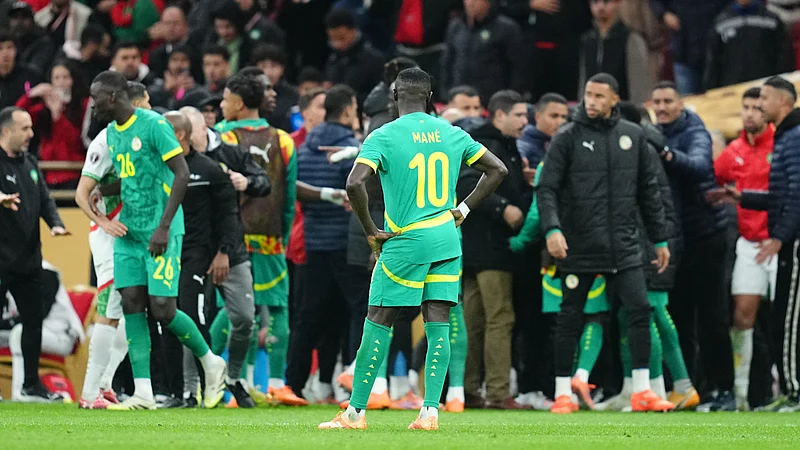
Senegal coach Pape Thiaw, already frustrated by an earlier disallowed goal, made a decision that shocked the football world.
He ordered his players off the pitch. Some followed immediately, disappearing into the tunnel.
Others hesitated, torn between loyalty to their coach and the magnitude of abandoning a continental final.
The stadium erupted—Moroccan fans hurled objects, journalists from both nations brawled in the press area,
and ball boys attempted to steal goalkeeper Edouard Mendy's towel.
For 17 agonizing minutes, the final hung in the balance. It was
Sadio Mane,
Liverpool legend and Senegal's talisman,
who restored order. He gathered his teammates, convinced them to return, and led them back onto the pitch.
What followed was pure poetry—Mendy saved Diaz's Panenka penalty,
and Pape Gueye scored the winner in the 108th minute. Senegal lifted the trophy, but the controversy overshadowed their triumph.
Sanctions: CAF fined Senegal $615,000 and banned Thiaw for five international matches.
Morocco received $315,000 in fines for fan misconduct.
FIFA president Gianni Infantino called the walk-off "unacceptable."
The Goalkeeper's Justice: AZ Alkmaar vs Ajax, 2011 Dutch Cup
The 2011 Dutch Cup semi-final between
AZ Alkmaar and
Ajax was a heated affair,
but no one anticipated the madness that would unfold in the second half. With tensions already high,
an intoxicated Ajax supporter somehow evaded security and sprinted onto the pitch,
making a beeline for AZ goalkeeper Esteban Alvarado.
The Costa Rican keeper, seeing the aggressor approaching with hostile intent,
did what any person might do—he defended himself. As the fan lunged at him,
Alvarado delivered a kick to the man's stomach, dropping him to the ground.
Security finally intervened, dragging the fan away. But incredibly,
referee Bas Nijhuis reached for his pocket and produced a red card—for Alvarado.
AZ manager Gert Jan Verbeek was apoplectic.
His goalkeeper had been attacked, had defended himself, and was now being punished while the aggressor was merely
escorted out. Verbeek made his decision instantly. He gathered his players and led them off the pitch in protest.
Resolution: The match was abandoned and later awarded 3-0 to Ajax by the
Dutch football association.
However, the incident sparked a national conversation about player safety.
Alvarado's red card was eventually rescinded on appeal, and new security protocols were implemented across Dutch football.
United We Walk: PSG vs Istanbul Basaksehir, 2020 Champions League
Few walk-offs have united rival teams quite like the night of December 8, 2020, at the
Parc des Princes.
What began as a routine Champions League group stage match between
Paris Saint-Germain and
Istanbul Basaksehir
became a powerful moment of solidarity.
The flashpoint came in the 14th minute. Istanbul Basaksehir assistant coach
Pierre Webo, a former
Cameroon international,
was involved in a touchline dispute when fourth official Sebastian Coltescu allegedly made inappropriate remarks.
Basaksehir substitute Demba Ba, the former
Chelsea striker, confronted the officials
on the pitch, and the Turkish players began walking toward the tunnel in the 23rd minute.
What made this walk-off unique was PSG's response. Stars
Kylian Mbappe,
Presnel Kimpembe, and
Neymar
didn't hesitate—they joined Basaksehir in leaving the pitch. Within minutes, both teams had abandoned
the match in an unprecedented show of unity.
Unity Prevails: The game was suspended and rescheduled for the following day with an entirely new officiating crew.
When play resumed 24 hours later, both squads knelt together at the center circle before kick-off.
PSG won 5-1, but the scoreline was secondary to the statement both teams had made—that some things
matter more than the result.
Senegal's Forgotten Walk-Off: AFCON 2004
Twenty years before their AFCON final controversy, Senegal had walked off before—with far harsher consequences.
The 2004 Africa Cup of Nations in
Tunisia saw Senegal as one of the favorites, still riding high from their
historic 2002 World Cup run where they defeated France in the opening match.
But their quarter-final clash against the host nation would end in disgrace.
When the referee awarded Tunisia a controversial penalty, Senegalese players erupted.
Feeling targeted by home-nation officiating, they made the fateful decision to abandon the match.
Unlike their 2026 walkout, there was no Sadio Mane to talk them back.
The players disappeared into the tunnel and refused to return.
Harsh Lesson: Tunisia was awarded a 2-0 victory, and Senegal's tournament ended in humiliation rather than glory.
The incident served as a painful lesson about the consequences of abandoning matches—a lesson that,
two decades later, they would come dangerously close to repeating before Mane's intervention
saved their continental crown.
When Walking Away Becomes the Only Option
Football's walk-offs represent moments when the sport's emotions overflow beyond the boundaries of acceptable protest.
They are acts of desperation, defiance, and sometimes, moral clarity. From Sheikh Fahad's unprecedented
pitch invasion to players standing united against injustice, these incidents reveal that football is never just a game.
What other football controversies should we explore? Share your thoughts and memories of matches that crossed the line.